

Unscannable

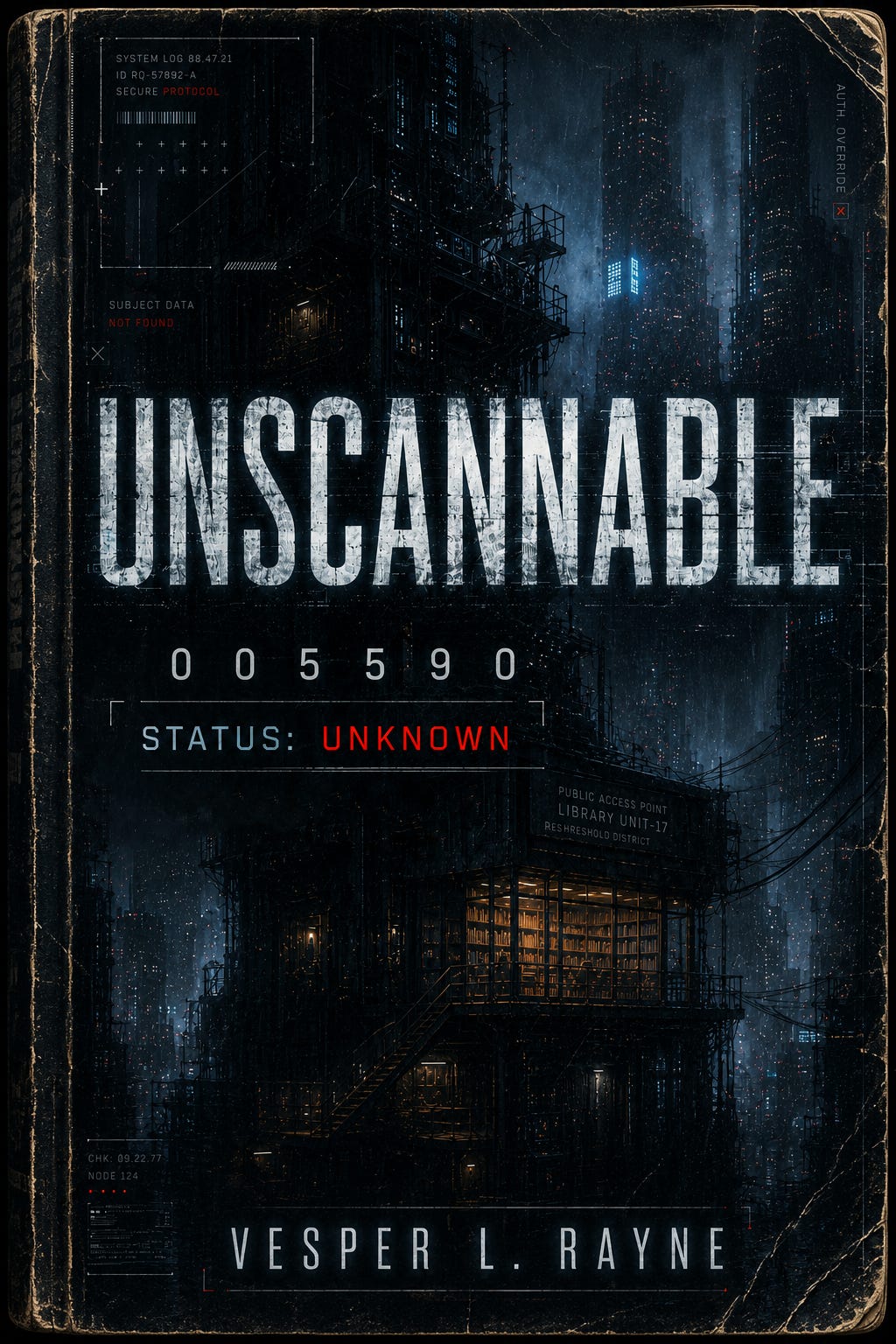
The rain had stopped an hour before the lines formed.
Lilly could still smell it, that particular clean that doesn’t last, the kind that sits on top of the grime and pretends, just long enough to fool you. She looked down at the rain-wet concrete. The way the light from the Allocation Center reflected back up, almost pretty if you didn’t look long enough.
She looked back up to the line in front of her. Not too many people tonight, it seemed.
“Mom.” Her son tugged her hand. “Can we get oranges this time?”
“Yeah.” She squeezed his fingers. “We can get oranges. Daddy would like some too, I’m sure.”
He considered this with the gravity only six-year-olds can bring to fruit. “He likes the big ones.”
“He sure does.” Lilly smiled, nodding.
They shuffled forward. She asked about homework. He said yes, there was homework, math, and it was fine — in the tone that meant it was not fine but he didn’t want to talk about it. The line moved and the beeping of the scanner filled in the background noise.
Above them, somewhere past the dark, a helicopter swept its light across the city in slow, pale arcs.
It was their turn.
“Good evening, miss. Identity number please?”
“Zero-zero-five-five-nine-zero.”
He nodded, tapped something she couldn’t see. “Please place your hand on the scanner.”
She did.
The readout came in silence. He looked at it — the cybernetic eye first, then the human one catching up.
Declined scan.
His smile faltered. Just a microsecond. She caught it.
So did he.
The woman in the adjacent line looked at her hair first. Then down. Then up. The full inventory.
She felt it the way you feel weather, before it arrives. She tilted her head the opposite direction. Didn’t give them her eyes.
She tucked a curl behind her ear.
“You are an Unscannable,” he said.
She nodded.
“You’ll receive the basic family ration.” A pause, gentle as a hand on a shoulder. “Would you like to upgrade? It only takes a second to reactivate your Allow-Scan. We can process it right here.”
Finn’s hand tightened in hers.
“No, thank you.”
She said it simply. Quietly. Chin lifted just a fraction, shoulders easy, Finn’s hand warm in hers. Her smile was pleasant and did not reach her eyes.
I see exactly what you are. I see exactly what this is. And I am still saying no.
Her eyes held.
“Surely for your son—”
The man glanced down at Finn, kindly, the way you look at something that surprises you into almost feeling it.
Then back up at her.
Finn stood straight beside his mother. “No thank you, Sir.”
Someone in line behind her made a sound. She did not turn around.
The man nodded once. Something moved behind his human eye — not the cybernetic one. That one had already moved on.
“Basic family ration,” he said quietly. “Have a good evening.”
She nodded. “You as well.”
And they walked through.
The food store was cold the way institutions are cold—not from the temperature alone but from everything soft having been removed from it.
The voice above them said: Welcome. Please scan before entering.
Lilly walked past the scanner without stopping. Finn’s hand was warm in hers.
One of the human supervisors glanced over. Then the other. The first one’s mouth moved, barely, something low and dismissive.
Slop.
Not even aimed at her directly. Just released into the air like it was nothing.
Finn’s head turned. His small face arranged itself into something fierce and certain.
Lilly looked down at him. “So, let’s get Daddy the big oranges, yes?” She kept her voice easy, gentle, like the word hadn’t landed. “And what about fresh strawberries? Can you help me see if they have any?”
He looked up at her. Nodded, still frowning.
She turned her head then, unhurried, deliberate, and found the supervisor’s eyes with hers. Just for a moment. Just long enough.
He looked away first.
She turned back to the produce section. Eyes forward. He wasn’t worth another second.
The oranges were stacked near the back wall, bright against the white shelving units. She was checking them, pressing gently, looking for the heavy ones, the ones her husband Hez liked, when she heard footsteps slow beside her.
“If you’re looking for strawberries, they’re just over there.”
She turned.
He was alone, the man from the Allocation Center. Small basket in one hand, enough food for one person, simple and sufficient and nothing extra. He was still in his uniform, the black tunic, the red diagonal stripe, but something about him looked different outside the Center. Smaller, maybe. More human.
His cybernetic eye found her first. Then the human one.
His eyes lingered on her curls before he seemed to recognize her. She watched it happen.
She gave him a smile that reached her eyes this time. “Thank you.”
Finn was already gone, darting toward the strawberries. For a moment it was just the two of them in the produce section, the cold bright air between them.
He turned slightly, as if checking the shelf beside her. His voice dropped, even and quiet.
“My daughter is like you.”
She looked at him. He didn’t look back. Just reached past her toward something on the shelf and that’s when he stumbled.
It was small, but his hand caught hers for balance, and something passed between their palms. Smooth. Small. No bigger than her thumbnail. “Forgive my clumsiness.”
Then Finn came running back, a small box of strawberries held up in triumph.
“Momma, look! I found some good ones!”
The man straightened. Smiled at the boy. Genuinely, she thought, as she saw the warmth in his human eye.
He nodded at her once. And walked away.
Lilly stood between the oranges and shelf, her son beaming up at her.
Lilly’s thumb smoothed over the tiny, hard surface in her pocket. An authorization token. The kind that added extra medical and food allotments directly to a household’s basic ration.
My daughter is like you, he had said.
She looked down at Finn and his strawberries.
“Good job,” she said. “Let’s get the rest of our stuff and get home.”
The border station hummed with the energy of people trying to be somewhere else.
It was late September and the air had that first real edge to it, the kind that meant business at night even if the day had been mild. Lilly shifted her grocery bags and looked down at Finn, his backpack bouncing, his hoodie very much inside it where it was doing nobody any good.
“Finn. Put your hoodie on.”
“I’m okay.” He looked up at her briefly. “I’m not cold.”
Lilly chuckled, shook her head. Didn’t push it.
That was when she heard it. The sharp sound of someone going down, a small cry cut short, the silence that opens up in a crowd when something happens that nobody wants to be responsible for.
Lilly was already moving.
Abbie was on the pavement, elegant even in falling somehow, black coat spread around her, blonde bob disrupted for the first time in what looked like its life. She was pressing her palm to the ground, trying to collect herself, and there was a scrape across her hand that was going to sting properly in about thirty seconds.
People moved around her in the particular way crowds do. Noting. Stepping aside. Not stopping.
Lilly crouched down. Finn was beside her a half second later, his small face arranged into something serious and helpful.
“Hey.” Lilly’s voice was quiet. “Here, let me help you.”
Abbie looked up.
Her eyes went to the curls next.
Lilly was already reaching into her jacket pocket for the small med kit before Abbie had fully processed that someone had stopped.
“Oh… I’m fine, really, you don’t need to—”
“You’re bleeding,” Lilly said simply, her face gentle.
Finn took the grocery bags from his mother without being asked, both of them, holding them carefully at his sides and watching the proceedings with the solemn attention of someone appointed to an important post.
Lilly uncapped the antiseptic spray. “This will sting a little.”
It did. Abbie’s breath caught but she didn’t pull away.
The bandage was slightly too big for the scrape. Lilly smoothed it down anyway, precise and unhurried, the way you do something you’ve done ten thousand times.
“My mom used to be a nurse,” Finn offered from behind the grocery bags. “She always carries bandages.”
Abbie looked at him. Something in her face went unguarded for just a moment, surprised loose by the absolute sincerity of him. “Thank you,” she said. To both of them.
They stood. Lilly snapped the med kit closed and tucked it away and extended her hand.
“I’m Lilly.”
Abbie hesitated for just a breath, then shook it. “Abbie.”
Lilly nodded down. “This is my son, Finn.”
Abbie looked down at him, Finn still holding both bags with great seriousness. “Hi, Finn.”
He nodded. Gravely. Like a small diplomat.
The LinX slid out of the border station with that low chest-hum, the city rising past the windows in dark glass and neon and steel, and the blur of somewhere becoming somewhere else.
Finn was asleep before the second stop.
He’d simply leaned into Lilly’s arm and been gone, his small face slack, the fierceness of the evening finally released into the uncomplicated business of being six and exhausted. She shifted her grocery bags carefully to her other side and let him stay.
Abbie watched him for a moment. Then looked out the window.
“So you used to be a nurse?”
Lilly smiled. “I did. I work at a library now. On the border, by the docking units.”
Abbie was quiet for a breath.
“I didn’t know there was a library there,” she said finally.
“Most people don’t.”
The LinX hummed. Outside, the Verified sectors began to glow whiter in the distance, the helicopter light finding its own.
“You didn’t scan me,” Abbie said quietly. “When you helped me.”
Lilly looked at her. “No,” she said. “I didn’t.”
Abbie looked down at the bandage on her palm. Small. Slightly too big for the scrape.
The announcement came soft overhead. Next stop, Connector Six. Verified sectors boarding.
Abbie stood. Smoothed her coat. Then looked at Lilly and the sleeping boy against her arm.
“Thank you,” she said, her voice soft.
“Take care of that hand,” Lilly said.
And Abbie stepped off into the cleaner light.
The LinX began to slow. That low hum shifted pitch, dropped, and Lilly felt the whole car settle downward with it, the momentum pushing gently forward before the doors released with a soft exhale.
“Come on, kiddo. Our stop.”
She kissed the top of his head gently as she said it. He blinked awake slow, with the disorientation of a child surfacing from real sleep, and squeezed her arm once before nodding and taking one of the bags himself.
Lilly caught his other hand in hers. Squeezed it gently.
They stepped out into a cool night. The concrete was wet, the way it always seemed to be here, holding onto the last rain long after the Verified sectors had dried and moved on to whatever came next.
This was the Unscanned district. It was older and the buildings wore their age without apology, graffiti half scrubbed into ghost shapes on brick, some of it new again already. Neon signs buzzed uneven, reflecting long and broken across the wet ground.
A PeaceKeeper stood at the corner. Fully cybernetic and motionless, the way only machines can be motionless, its optic sweeping the street in slow even arcs. Further down, two more. These ones half human, the cybernetic half hidden under the uniform.
Lilly kept her gaze forward. Not avoiding them. Just careful, the way you’re careful around something that could decide, at any moment, that carefulness wasn’t enough.
Finn’s hand stayed tucked in hers.
They walked on. The PeaceKeeper units thinned as the streets narrowed, the buildings pressing closer together in that comfortable way old cities do when nobody’s had the money to modernize them into something colder.
One of the half-cybernetic units stood near the corner store, human half unmistakable in the way he shifted his weight, tired, waiting for shift change. His human eye found Lilly’s for a moment.
She nodded. Small. Just enough.
Something in his face answered it, some small thing untouched by the cybernetic half, and then he looked back to the street.
The streets grew warmer as they went. Not in temperature. In something else. Windows lit gold instead of white. A woman leaned out over a balcony calling something to a child below. Someone’s radio, old and crackling, playing music that hadn’t been approved by anyone in a long time.
The ramen shop sat at the base of their building, golden light spilling out onto the wet pavement, steam curling from the vents above like the building itself was breathing.
Finn saw him before Lilly did.
“Mr. Tanaka!” He was off before she could catch his hand again, small feet slapping the wet concrete, the strawberries forgotten in his excitement. “Mom got oranges. Here.” He held one out, both hands, like an offering.
The old man came around the counter, wiping his hands on his apron, his face folding into the smile Lilly had come to know so well, eyes disappearing into half moons, cheeks going round and rosy under the shop lights.
He took the orange with both hands and turned it over, examining it with the seriousness of a man appraising something rare.
“Ahh. Very good eye, Finn-kun. This one is perfect. Heavy. You feel the weight?”
He rolled the orange gently into Finn’s palm.
“Heavy is good.”
Finn nodded solemnly.
“My grandmother used to say oranges carry little pieces of the sun.” He smiled. “Sunshine you can eat.”
Finn looked down at the orange in his hands, turning it slowly as if he might catch the light hiding inside.
Mr. Tanaka disappeared behind the counter and came back with a bag, the smell of broth and soy and something ginger rising out of it.
“Here.” He pressed it into Lilly’s hands before she could protest. “I had a customer, never came to pick this up. Would go to waste otherwise.”
Lilly took it. Held his gaze for a moment, and let herself be grateful without saying so out loud, the way he’d let her be proud without making her say thank you.
“You’re too kind to us,” she said anyway.
He waved a hand, already turning back toward the shop. “Your husband fixed my stove for two years before I even knew your name. This is nothing.”
Upstairs in their apartment, the kitchen was cozy in the way kitchens get after the whole day has already happened. Tea steam curling up past Lilly’s hands. A bit of the leftover noodle broth had been saved for tomorrow. The smell of ginger and soy and garlic fading. The overhead light doing that soft yellow thing it did in the evenings, nothing like the store’s white glare.
Hez sat at the table peeling the big orange, the one Finn had picked out with tremendous care. He did it the way he always did, one long unbroken spiral, the peel curling down onto a paper towel like something he was unwinding rather than removing.
Finn sat beside him, chin propped in his hand, watching like it was the only thing happening in the world. Maybe it was.
“You get the big one every time,” Finn said.
“Your mom picks well.” Hez glanced at Lilly with a little grin.
Lilly wrapped both hands around her mug and watched them. The scrape of the chair when Finn shifted closer. The particular quiet of Hez concentrating on something small.
She watched this man focus on the orange, taking in the curve of his jaw, the stubble already forming, how his brows furrowed slightly and she felt that warmth at her chest spread down and out, the one she always got when she looked at him.
“I should get up,” she said. “Do the dishes.”
“No.” His gaze caught hers. His sky blue eyes meeting her honey brown ones. “Let me.”
She didn’t argue. She’d learned a long time ago that some things were worth losing on purpose.
He finished the spiral, set it aside whole and unbroken, and split the orange into sections. Held one out to her across the table. She took it. Ate it slow.
Somewhere past the window, faint enough to almost not notice, the helicopter made its pass. The light didn’t reach them here. The kitchen held.
Finn got orange juice on his chin and didn’t notice. Hez reached over and wiped it with his thumb, easy, automatic, the kind of gesture you do a thousand times without thinking about the thousand and first.
Lilly watched her husband and her son and thought, not for the first time, that this was the whole of it. This was everything worth the basic ration.
Later that night, Lilly helped Hez with the nightly ritual of caring for his cybernetic arm and leg.
She knelt in front of him, unhooking the anchors at his knee with practiced hands, the small clicks and releases as familiar to her now as breathing. He sat still and let her work, the way he always did, trusting her hands over his own in this one particular thing.
She eased the leg free and carefully tended to the connectors, wiping them clean gently with a soft cloth, looking to be sure there were no leaks, no grime. Then she carefully examined Hez’s leg, the base where the cybernetic leg connected, and did the same thing. Wiped it, checked it. Wiped it again.
“The skin still looks good. You have an appointment at the Veteran’s Clinic next month?” she asked as she handed him the leg to reconnect.
Hez reconnected the leg and locked it, moving it to be sure it was okay, like he always had. He nodded, “Yup, got it set.” Then his eyes found hers again.
She repeated the process with his arm. When she was done, she helped him reconnect it, watching him roll his shoulders, then how he flexed the robotic fingers to ensure the connection was solid.
Hez reached for her without a word. His hands, the one warm flesh and the one cool carbon fiber, both finding her waist and pulling her into his lap like she weighed nothing, which to him she probably didn’t. Lilly settled there, leaning into the crook of his shoulder, letting the comfort of him, solid and strong, carry her.
He kissed her slowly. The kind of slow kiss that had always left her breathless.
When he pulled back his sky blue eyes were close and soft and a little tired in the way she loved, the tiredness that was just the day leaving him.
“Thank you,” he said quietly.
She smoothed her thumb along his jaw, the stubble catching. “You could reactivate the scan, Hez. The veteran benefits alone would cover the leg maintenance. You’ve earned that.”
He shook his head. Once. “I’ve seen enough of division.” His voice was low and even. “I won’t participate in that anymore.”
She looked at him for a moment. At this man who had given up more than she ever had and never once made her feel the difference.
She cupped his face in both hands and kissed him.
The light stayed on for a little while longer.
Then it didn’t.
Lilly was shelving returns near the front when the door hummed open.
Abbie stood in the doorway, her polka dotted tote over one shoulder, taking in the room with the careful stillness of someone who had been told about a place and was now checking it against what they’d imagined. The cream jacket. The perfect bob. A little less certain than she’d been on the LinX platform.
Lilly watched her eyes move across the space. The woman nursing her newborn in the corner, her older son beside her working through something on his tablet with a focused frown. The little girl with careful braids bent over her screen in the children’s section. Finn, chin propped in his hand, stylus moving, not looking up.
People in chairs and window seats with the ease of people who came here often. Like it was theirs.
Then Abbie looked for the scanner.
Lilly could see the exact moment she realized there wasn’t one. The small pause. The second sweep of the room, certain she’d missed it.
She hadn’t.
Lilly came around the end of the shelf.
“Abbie.”
Abbie’s eyes found her. Something in her shoulders released, just slightly, like she’d needed a familiar face to know where to put herself.
“Hi.” She shifted her weight slightly. “I, um. I didn’t see a sign. For the scanner. Where do I—”
“We don’t scan here.” Lilly smiled. “Everyone’s welcome to come in. No verification required.”
Abbie looked at her. “Oh.”
Just that. Just oh. Like the word needed a moment to land.
Lilly let it. Then, gently, “Is there something I can help you find? A book you were looking for?”
“I don’t know.” Abbie’s hands found the strap of her tote. “I haven’t read. Much. I mean, I’ve read, obviously, but not. Not like.” She stopped, took a breath. Started again. “I don’t really know what I like.”
Lilly considered her for a moment with those honey-brown eyes that didn’t seem to need anything back from you.
Lilly set her stack of books down and reached for the tablet on the desk, pulling it up with the ease of someone who’d done it ten thousand times.
“Here.” She turned it toward Abbie. “This is our digital catalogue.”
Lilly watched as Abbie leaned in. The interface was clean, simple. Search by author. By genre. Books for adults, young adults, children. Just like any library would do.
“You can browse however you like,” Lilly said. “And if there’s something you’re looking for that you can’t find, I can usually help track it down.” She tapped the screen gently. “Here, try fiction.”
The tabs categorized — Adult, young adult, children’s.
Abbie stared. She clicked on young adult. Her eyes widened for a breath. Lilly could tell she was looking for the “SCANNED” badge.
It was not there.
“These are…” She looked up. “These aren’t scanned?”
“No.” Lilly’s voice was quiet and even. “None of them.”
Abbie looked back at the screen. At all those titles sitting there unverified, unrated, unranked. Just existing. Just available to anyone who walked through a door that had no scanner beside it.
Abbie was quiet for a moment. Then she looked up.
“What’s your favorite book?”
Lilly smiled. “Come here, I’ll show you.”
Abbie stayed in the back room where they kept the old books, the ones from before The War, before scanners, before now, for two hours.
Lilly checked on her once, quietly, and found her sitting cross-legged on the floor between the shelves with the book open in her lap, her perfect bob falling forward, her cream jacket folded beside her. She didn’t look up. Lilly left her alone.
When she came out, she had a thoughtful expression and that look of having just experienced something new that challenged something inside you.
“I’d like a library card,” she said. Like she’d decided it in there among the shelves and was simply reporting the decision.
“Of course.” Lilly pulled up the tablet. “I’ll send it to yours. What’s your device ID?”
Abbie told her. A small ping on her own tablet a second later confirmed it.
“That gives you access to the full digital catalogue,” Lilly said. “Scanned and unscanned both. Read anything on the list from anywhere.”
Abbie looked at her tablet for a moment. The card sitting there quietly among everything else. Unremarkable. Invisible to anyone who didn’t know what they were looking at.
She tucked it into her tote.
“Thank you,” she said. And meant, Lilly thought, considerably more than the words.
Lilly watched Abbie as she gathered her things and moved toward the door, the warm room parting around her. The nursing mother gone now, the children’s section quieter. Finn still at his table, stylus moving.
Abbie was almost to the door when she stopped.
The poster had been there so long it had become part of the wall. Sun faded at the edges, the colors gone soft with time, an abstract wash of deep blues and golds framing the words in bold letters that had outlasted everything the world had done since they were printed.
Lilly watched her read it. She knew the poster. The one with Martin Luther King’s words, the passage she had memorized so long ago.
“I have a dream that my four little children will one day live in a nation where they will not be judged by the color of their skin but by the content of their character.”
She watched Abbie stand there and take it in, still and quiet in a way she hadn’t been since she walked through the door.
Then Abbie looked back.
Just one breath. Her eyes finding Lilly’s across the room, the shelves, the amber light between them.
Then she turned and walked out into the cool evening.
Lilly looked at the poster for a moment after she was gone.
Then she went back to work.
On Friday, Lilly had three hours before closing.
She was at the desk working through the new digital acquisitions, three short story anthologies and a collection of essays that had come through that day, tagging them into the catalogue with the quiet focus the work always brought her. In the back office, she could hear the an occasional giggle from Finn as he watched cartoons.
She smiled without looking up.
She was halfway through the second anthology when the door hummed open.
Lilly glanced up.
Abbie. Same perfect bob, a softer coat today, the polka dotted tote over her shoulder. And beside her, a girl Lilly gathered to be around thirteen maybe, that particular age that hadn’t quite decided what it was yet. Looking around the library with wide open eyes that hadn’t learned yet to pretend they weren’t curious.
Abbie walked up to the desk. “Hi again.”
Lilly smiled. “Hey there.”
“I brought my little sister.” Abbie turned slightly, drawing the girl forward. “I wanted her to get a library card.”
“Sure, of course.” Lilly reached for her tablet, pulled up the registration. “I can get you set up.” She looked at the girl directly, those wide open eyes still drinking the room in. “What’s your name?”
The girl looked at her. “Hope. My name is Hope.”
Lilly smiled.
“Welcome, Hope,” she said. “Let’s get you your card.”
Vesper, you are on a creative burst. Good for you. I like the themes on this one, and the role a library plays in it. I’m rather partial to those. 😊
I want to be mad at you. For writing such a long piece. For two articles two days in a row with no Calloway County. And I just can't. It all seems to be so perfect no matter what genre you're writing in. I, of course, want more.